The sync engine for , ,
, applications.

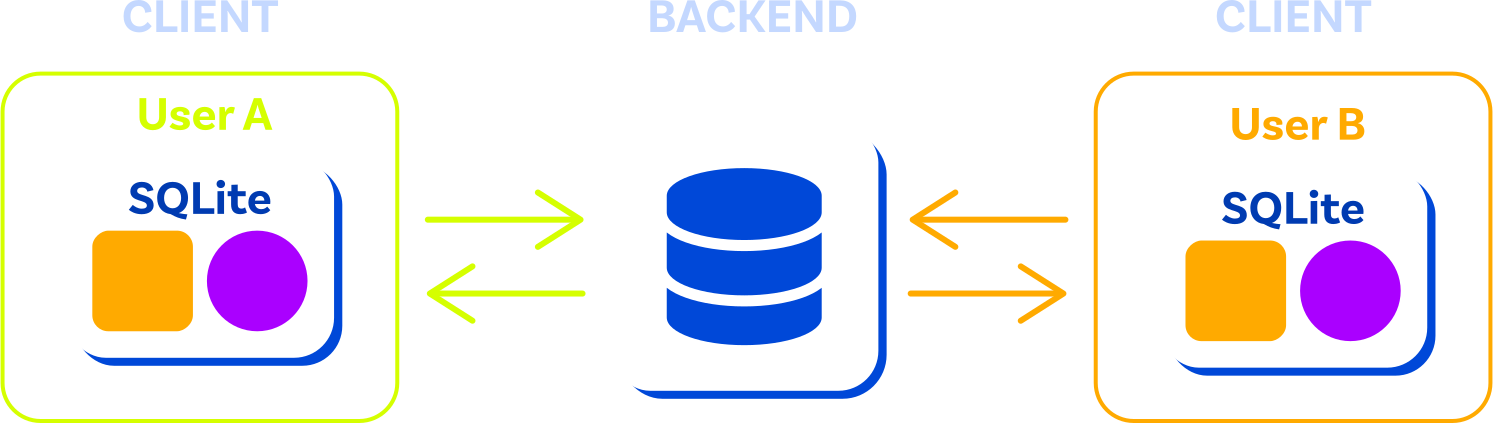
PowerSync keeps a local SQLite database for every user in sync with the backend database you already have. One sync architecture enables high-quality software across every platform – web, mobile, desktop embedded/headless and agents.

Backend
Database

PostgreSQL
MongoDB
Azure DocumentDB
MySQL
Microsoft SQL Server

Client-side
SQLite

SQLite
PowerSync dinosaur mascot in the page header
Connects to these backend databases
Client SDKs available for these platforms
JavaScript
React Native
Vue JS
Electron
Capacitor
Tauri
Svelte
Next JS
Nuxt
Flutter
React Expo
Kotlin Multiplatform
Swift
Node.js
.NET
Rust
Bi-directional backend <> frontend state synchronization

Your existing database, synced automatically

PowerSync is a sync engine that consists of two components: a service that integrates with your existing backend database to enable highly-scalable partial data syncing, and a set of client SDKs that manage client-side data: persistence in SQLite with real-time streaming updates and consistency guarantees, instant UI reactivity, and syncing write operations back.

Backend DB
PostgreSQL
MongoDB
Azure DocumentDB
MySQL
Microsoft SQL Server
PowerSyncService
PowerSync
Backend API
PowerSync
PowerSync SDK
Client-side
SQLite
SQLite
auto-synced
real-time
reactive
Server-side
State transfer managed for you
Client-side
Fast, responsive, real-time, local-first apps
Snackpass
Four huge gains from one architecture

Raise the bar for software quality with sync

Many types of software applications benefit from sync: Mobile & desktop apps. Web apps that should be fast and real-time. Apps that sync AI-generated responses, results or progress updates to users. Agents that need up-to-date state in their sandbox.

Real-time

Database updates propagate to clients in real-time, and reactive queries refresh automatically. No need to build your own streaming plumbing (e.g. WebSockets)

Super-fast

Reads and writes in the application hit the local SQLite database first. Near-zero latency. No network round-trip. Instant, optimistic UI responsiveness.

Consistent

PowerSync assures the SQLite DB is always consistent: no missing data (based on your sync config), and updates applied as fully-committed transactions in causal order.

Network-resilient

You pick: Full offline SQLite persistence (even in web apps) so that the app can reload even if the network is down, or in-memory to survive temporary network blips.

LESS CODE BLOAT AND COMPLEXITY, MORE POWERFUL APPS

Agent & dev friendly

In a typical API-based architecture, significant complexity and bloat is needed to make software real-time, fast, consistent and network-resilient. That's a lot of context for AI coding agents to manage.

By abstracting state management into a robust sync architecture (that handles things like authorization and client-specific partial syncing declaratively), PowerSync reduces your API surface and code complexity, resulting in a simpler, more legible codebase for you and your coding agents to reason about.

Backend
API
Typical API-based software
loads of boilerplate
state management
API bloat
cache invalidation
optimistic updates
loading states
custom sync code
The power of sync
Backend
Synced in background
Client-side
SQLite
BRING YOUR OWN BACKEND, SYNC WITH SQLite

Built to leverage open database technologies

Rather than requiring you to adopt a new database, PowerSync connects the most mature and widely-used open-source & source-available databases: Postgres, MySQL, MongoDB, SQL Server or Azure DocumentDB on the backend, and SQLite on the client-side.

PowerSync itself is also open-source & source-available.

The Power of SQLite on the Client-Side

SQLite
Client-side SQLite

Inspectable
Easy to inspect, query, and debug
Extensible
Many extensions & ORMs available
Powerful
Joins, aggregations, JSON, etc.
Versatile
Works well with both document data (with strong JSON support) and relational data
PowerSync Client SDKs add:
Bi-directional automatic partial syncing
Real-time reactivity
with live queries
Painless schema
evolution
Backend DATABASE, meet SQLite

How PowerSync works

On the backend
Backend database
PostgreSQL
MongoDB
Azure DocumentDB
MySQL
Microsoft SQL Server
1

The PowerSync Service connects to your source database.

Change stream
2

The PowerSync Service continuously replicates data by tracking changes in the source database.

PowerSync Service
Partial sync
3

Data is dynamically partitioned with Sync Streams you define, allowing each client to efficiently subscribe to just the data they need.

Real-time streaming
4

Updates are streamed to each client in real-time, based on its specific Sync Streams subscriptions

On the client-side
PowerSync Client SDK
SQLite
Client-side SQLite

App data tables
Data tables
Upload queue
Upload queue
5
6

The PowerSync client SDK keeps a client-side SQLite database updated (persistent or in-memory), enabling network-resilience and/or offline-first functionality.

Writes are applied locally, and queued for upload to your backend API.

On the backend
Backend
API

Live demo app

React Multi-Client Demo App (PowerSync + Supabase)
Diagram of a demo app with multiple React Native clients

Get started

Self-hosted PowerSync
Self-hosted PowerSync illustration
Self-host PowerSync

Join thousands of developers using PowerSync

“PowerSync is really bulletproof — every single kind of interaction that you might have with the data, it's got covered.”
Tyler Shukert
Tyler Shukert
Supabase
“Combining Riverpod, Drift, and PowerSync creates a powerful stack that makes local-first development approachable. You can focus on building features rather than wrestling with complex sync logic.”
Dinko Marinac
Dinko Marinac
Dinko Marinac's Blog
"Been playing with PowerSync recently - it's amazing and straightfoward after you get an understanding of their architecture and min concepts which is not that hard. Also fully open source and you can self-host. It's in its early days but team on discord is extremely helpful."
Bhodan Khodakivskyi
Bhodan Khodakivskyi
fomr.io
"It's been a long-time dream of mine to eliminate all client state management with queries to a local DB. This is probably the closest thing I've seen to that vision."
Ev Haus
Ev Haus
ZenHub
"As a developer, this feels like a game-changer: I get incredibly robust data sync with LESS code."
Carl Kritzinger
Carl Kritzinger
Intuitably
"I'm using @powersync_ to sync data to sqlite wasm in the browser. Magic."
Zane Thomas
Zane Thomas
"The number of people I talk to about PowerSync on a daily basis 😂 It reminds me of the advertising I used to do for Glassy, so much so that people would ask me if I'd invested in it."
Steve Nosse
Steve Nosse
BeFit
"The main reason we chose PowerSync is that it perfectly fits our need for an offline-first architecture. Before discovering it, we hadn’t come across any other solutions that offered a robust offline-first sync option."
Andy Geers
Andy Geers
PrayerMate
"PowerSync makes it easy to set up local-first without messing up the architecture of the rest of your system."
Simon Grimm
Simon Grimm
Galaxies.dev
"Smooth cross-platform syncing feels like magic on @orakemu. Works great offline too. Thanks to @powersync_"
Yorgo Hoebeke
Yorgo Hoebeke
Orakemu
"I built recall.plus offline-first with @powersync_ - game changer from a UX perspective as the latency between user actions and the local db is almost non-existent."
Martin Dyz
Martin Dyz
recall.plus
"Lately, I’ve been working on a project that combines Supabase, PowerSync, and Flutter. The results so far? Absolutely game-changing! This stack makes it so much easier to handle offline-first functionality without overcomplicating the architecture."
Alvaro Carillo Rumpel
Álvaro Carillo Rumpel
Mobile Engineer
“Integrated @powersync_ into an experimental branch of @HabitKit. Setup was pretty easy and fast. Really love the developer experience and I'm amazed how good it works 🤩”
Sebastian Röhl
Sebastian Röhl
HabitKit
"Building with a sync engine like @powersync_ means I get instant reactivity for free, without having to write repetitive boilerplate code to manage websockets and API endpoints."
George Jose
George Jose
Titan Gym App
"Finally, my offline first app with @supabase + @powersync_ is live! I used to use @realm and switched to @powersync_ this time, so far so good! Excited to see how will be on production 💪"
Minho Ko
Minho Ko
nomadwallet.app
"I have a project that I am currently working and testing with @powersync_. It's working flawlessly..."
Marco Napoli
Marco Napoli
Jedi Pixels

Explore the PowerSync community

Blog
Blog

We post about product updates, announcements and interesting engineering challenges we've faced.

Discord
2K+ MEMBERS

Join the PowerSync Discord server to get support, talk to our engineering team and share what you've built.

GitHub
1.9K STARS

View the repositories of our client SDKs, the server-side PowerSync Service and other packages.

Join the PowerSync community on

Key PowerSync features

Even with cutting-edge coding agents, some things don't come easy. A well-designed fundamental architecture with high performance at scale, and battle-hardening to cover real‑world edge cases require careful engineering. That's the foundation that PowerSync provides developers and their coding agents.


Decorative green hills behind the key features section